What Does “T” Mean in a Roll Grooving Dimension Table?
When reading a roll grooving dimension table, you may see a parameter marked as “T.”
The meaning is actually quite simple:
T = Minimum Allowable Wall Thickness
In other words, T tells you:
How thick the pipe wall needs to be, at minimum, for that pipe size.
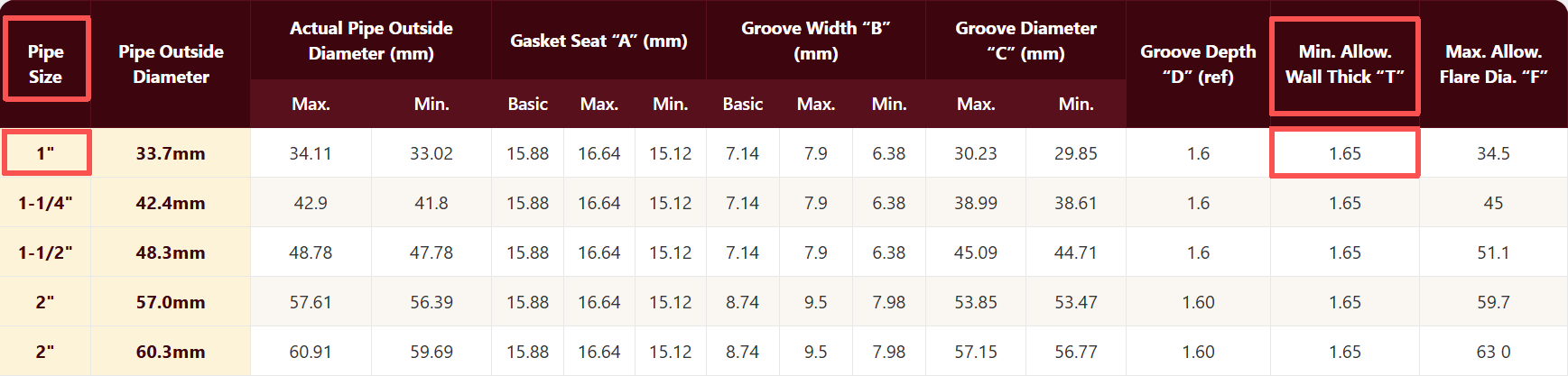
1. First, Look at the T Value for a 1" Pipe
Let’s use a 1" pipe as an example.
In the roll grooving dimension table, the T value for a 1" pipe is:
T = 1.65 mm
That means:
For a 1" pipe, 1.65 mm is the minimum allowable wall thickness shown in the table.
For now, you only need to remember one number:
1" → T = 1.65 mm
2. So, How Thick Is a 1" Pipe in Practice?
Now look at the pipe wall thickness table.
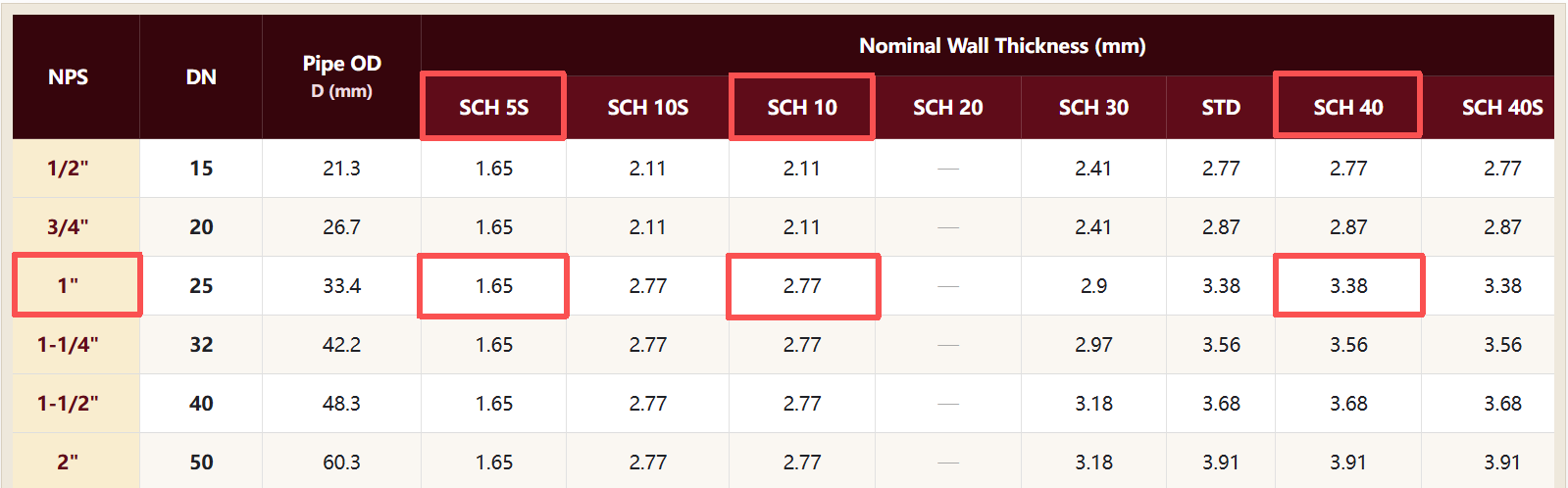
For the same 1" pipe, different Schedule ratings have different wall thicknesses.
For example:
| Pipe Schedule | Wall Thickness |
| SCH 5S | 1.65 mm |
| SCH 10 | 2.77 mm |
| SCH 40 | 3.38 mm |
This table is not about groove dimensions. It simply tells us:
How thick the pipe wall actually is under each Schedule.
3. Put the Two Tables Together
Now the meaning of T becomes much easier to understand.
The first table tells us:
1" pipe → T = 1.65 mm
The second table tells us:
1" SCH 5S → wall thickness = 1.65 mm
So: SCH 5S is already at the minimum allowable wall thickness shown for this pipe size.
This is the main purpose of T.
It helps you check whether the pipe wall is below the minimum thickness shown in the grooving table.
4. But T Is Not the Working Range of the Roll Set
This is an important point. Seeing: T = 1.65 mm
does not mean: Every pipe from 1.65 mm upward can use the same standard roll set.
That is not what T means.
T only tells you the minimum wall thickness.
To choose the correct roll set, you still need to look at the actual pipe wall thickness.
5. What Pipe Thicknesses Do Gruvmaster Standard Roll Sets Cover?
For Gruvmaster roll grooving machines, the standard roll sets are mainly designed for:
SCH 10 to SCH 40
Using a 1" pipe as an example:
· SCH 10 = 2.77 mm
· SCH 40 = 3.38 mm
These common wall thicknesses can normally be grooved with the standard roll set.
If the pipe is thinner than SCH 10 or thicker than SCH 40, a different roll set may be required.
6. Why Do Thinner Pipes Need Special Rolls?
Take SCH 5S as an example.
For a 1" pipe, SCH 5S is only 1.65 mm thick.
Because the pipe wall is very thin, it is easier to deform during grooving.
Possible problems include:
· Pipe end deformation
· Excessive flare
· Groove dimensions that are harder to control
· Less stable groove formation
For this reason, pipes below SCH 10 usually require a special roll set designed for thin-wall pipe.
The goal is to control pipe deformation and achieve more consistent groove quality.
7. Why Do Thicker Pipes Also Need Special Rolls?
The opposite problem appears when the pipe wall becomes thicker than SCH 40.
A thicker pipe is more rigid and requires more forming force to create the groove.
This places higher demands on:
· Roll geometry
· Forming capacity
· Machine pressure
· Grooving efficiency
So, for pipes above SCH 40, the roll set usually needs to be selected or customized according to the actual pipe size and wall thickness.
8. The Easiest Way to Understand T
If you only remember one sentence, remember this:
T tells you the minimum pipe wall thickness. Schedule tells you the actual pipe wall thickness.
Then, use the actual wall thickness to choose the right roll set.
For a 1" pipe:
· T = 1.65 mm
· SCH 5S = 1.65 mm
· SCH 10 = 2.77 mm
· SCH 40 = 3.38 mm
For Gruvmaster roll grooving machines:
· SCH 10–SCH 40: standard roll set
· Below SCH 10: usually requires a thin-wall roll set
· Above SCH 40: usually requires a heavy-wall roll set
Summary
Understanding T in a roll grooving dimension table is not complicated.
You only need to remember:
T means the minimum allowable wall thickness.
It is not the recommended wall thickness, and it is not the full working range of the standard roll set.
First, check T to see the minimum wall thickness for that pipe size.
Then, check the pipe Schedule or actual wall thickness to decide which roll set should be used.
For Gruvmaster roll grooving machines, standard roll sets are mainly designed for common pipes from SCH 10 to SCH 40.
For thinner or thicker pipes, a special roll set may be required depending on the actual pipe size and wall thickness.
FAQ
Is T the actual pipe wall thickness?
No. T is the minimum allowable wall thickness shown in the roll grooving dimension table.
The actual pipe wall thickness can be greater than T.
If the pipe wall is thicker than T, can I use the standard roll set?
Not always.
You still need to check the pipe Schedule, actual wall thickness, and the working range of the roll set.
Can SCH 5S pipe be roll grooved?
First, check whether its wall thickness reaches the T value for that pipe size.
However, because SCH 5S is very thin, it usually requires a roll set designed specifically for thin-wall pipe.
What range do Gruvmaster standard roll sets cover?
They are mainly designed for common pipes from SCH 10 to SCH 40.
Thinner or thicker pipes usually require a different or customized roll set.