Why Do Extra-Thick-Wall Pipes Sometimes Require a Larger Cylinder Effective Area?
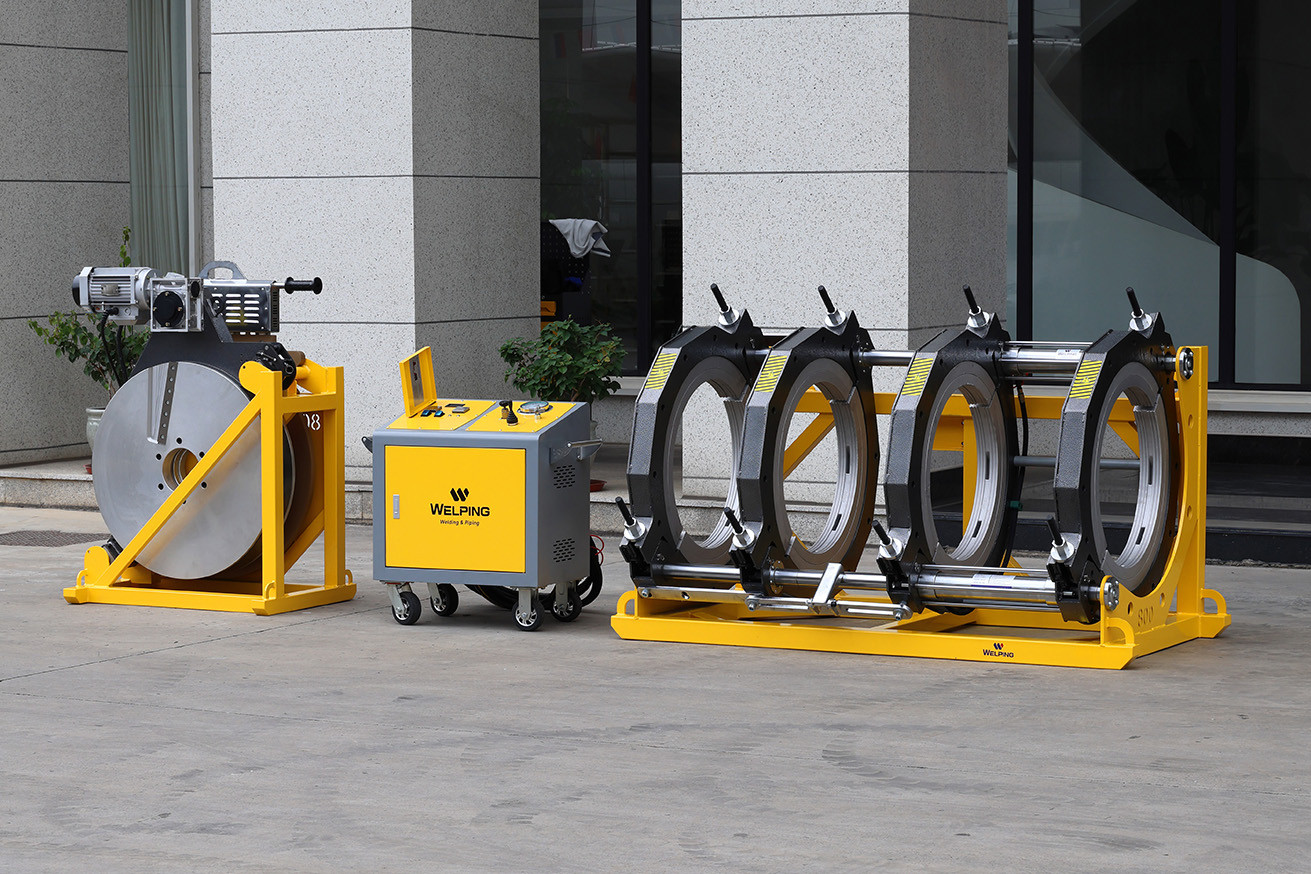
During a recent discussion with a customer about 800 mm and 1000 mm butt fusion machines, we received a rather specific request:
the customer wanted the machine’s effective piston area increased to approximately 5000 mm².
For reference, the effective area on our current 800 mm machine is around 3200 mm², while the 1000 mm model is approximately 3650 mm².
At first, this may sound like a simple hydraulic specification change.
But after discussing the application in more detail, the reason became clear: the machines will be used for large-diameter, extra-thick-wall HDPE pipe, where significantly higher fusion force may be required.
1. Why does the customer need a larger effective piston area?
The machines are intended for low-SDR pipe applications, including pipe such as SDR 7.4.
On large-diameter pipe, especially in the 800 mm and 1000 mm range, a low SDR can mean extremely thick pipe walls. In some cases, wall thickness can exceed 100 mm.
As pipe diameter and wall thickness increase, the fusion interface area also increases.
That means the machine must provide more actual force during the fusion process in order to achieve the required joining pressure.
So the real requirement is not simply: “a larger cylinder.”
The real requirement is: more available fusion force.
2. Why does effective piston area affect output force?
The basic relationship is simple:
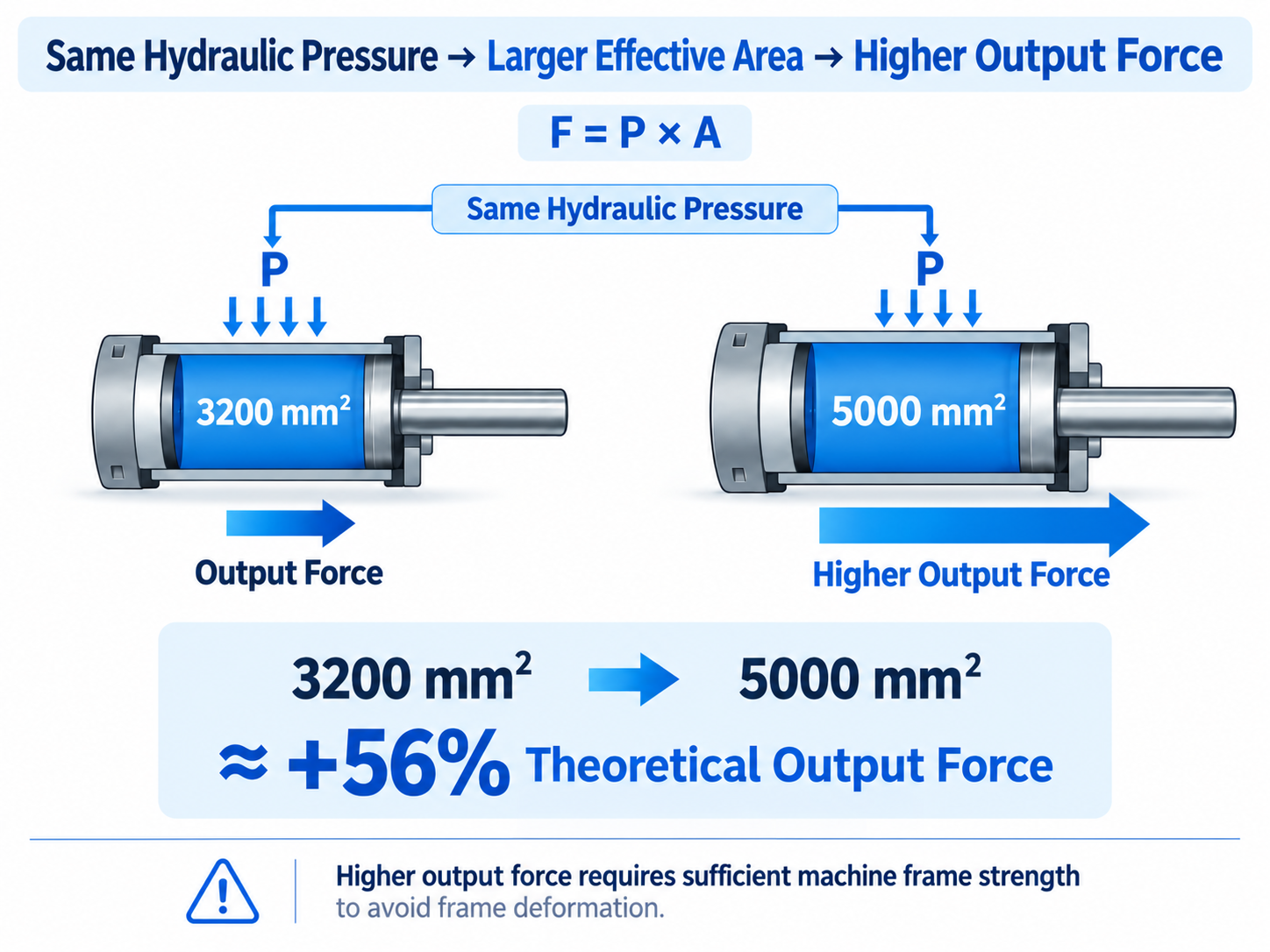
F = P × A
where:
· F = theoretical cylinder output force
· P = hydraulic pressure
· A = effective piston area
This means:
At the same hydraulic pressure, a larger effective piston area produces a higher theoretical output force.
One important point should be clarified:
Increasing the effective piston area does not increase the hydraulic pressure itself.
The pressure shown on the gauge can remain the same.
What changes is the amount of force generated from that pressure.
This is why increasing the effective piston area can be useful in applications where additional fusion force is required.
3. What does an increase from 3200 mm² to 5000 mm² mean?
Take the 800 mm machine as a simple example.
Current effective piston area:
3200 mm²
Requested effective piston area:
5000 mm²
The ratio is:
5000 ÷ 3200 ≈ 1.56
So, at the same hydraulic pressure, the theoretical output force would increase by approximately 56%.
In simple terms:
Same hydraulic pressure → Larger effective area → Higher output force
This is the main reason the customer is interested in a larger effective piston area.
The goal is to provide more force capacity for large-diameter, extra-thick-wall pipe applications.
The 56% figure is a theoretical value. In actual operation, mechanical friction, seal resistance and other system losses will reduce the available force to some extent.
4. More force also requires a stronger machine frame
Increasing cylinder force is only one part of the design.
A higher output force also means that the machine frame must withstand a higher axial load.
This affects several parts of the machine, including:
· frame rigidity
· guide structure
· clamps and inserts
· cylinder-to-frame connection
· overall structural stability under high load
If the frame is not strong enough, excessive force may cause structural deformation.
This can affect pipe alignment, fusion stability and long-term machine durability.
For this reason, a high-force butt fusion machine should be considered as a complete system:
Larger effective piston area + suitable hydraulic capacity + sufficient machine frame strength
These elements must work together.
5. Maximum pipe diameter is not the only specification that matters
When selecting a butt fusion machine, many users first ask about maximum pipe size.
For example:
“Can this machine weld 800 mm pipe?”
“Can it handle 1000 mm pipe?”
But for thick-wall applications, maximum diameter alone does not tell the full story.
Two pipes with the same outside diameter can have very different wall thicknesses depending on their SDR.
Different wall thickness means a different fusion interface area, and therefore a different force requirement.
For large-diameter or low-SDR projects, it is important to consider:
pipe diameter, SDR, wall thickness and required fusion force.
Together, these parameters determine whether a machine is truly suitable for the job.
Conclusion
The customer’s request to increase the effective piston area to approximately 5000 mm² may look like a simple specification change.
In reality, it reflects a much broader requirement: achieving sufficient fusion force for large-diameter, extra-thick-wall HDPE pipe.
For standard applications, a conventional hydraulic configuration is usually sufficient.
But as pipe diameter increases and SDR becomes lower, fusion force and machine frame strength become increasingly important.
The principle is simple:
A larger effective piston area produces more force at the same hydraulic pressure. More force, however, also requires a stronger machine structure to handle it safely and reliably.
Both should always be considered together.